
 The Scientific Advice Mechanism to the European Commission has delivered a new report and recommendations on how artificial intelligence can support emergency and crisis management across Europe.
The working group existed of Tina Comes (Chair), Verónica Bolón-Canedo, Joachim Denzler, Nick Jennings, Thomas Kox, Markus Reichstein, Christian Reuter and Andrej Zwitter.
The findings reveal a nuanced picture:
- AI demonstrates significant potential for standardised, data-intensive tasks common in recurring disasters such as floods, wildfires, and droughts. It excels at continuous monitoring for early warning systems and can analyse social media and assess damage at scales and speeds that human analysts cannot match.
- Yet, AI has its limitations. It struggles with highly heterogeneous contexts and novel situations where training data is scarce. Critically, the report emphasises that morally challenging decisions and ethical trade-offs must remain in human hands.
- The report highlights the importance of: ensuring AI tools meet European standards for safety, transparency, and ethics; developing benchmarks and sandbox environments to test AI under supervision before deployment; and establishing a European crisis management data preparedness framework to harmonise standards across Member States.
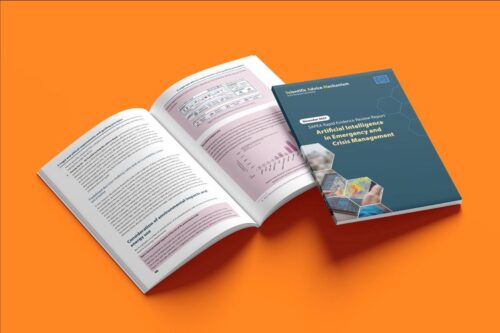
The Group of Chief Scientific Advisors are complementing the report with a series of recommendations. Follow this link to read the full SAPEA report and GCSA recommendations. https://scadv.eu/EgKkhND
Tina Comes, Verónica Bolón-Canedo, Joachim Denzler, Nick Jennings, Thomas Kox, Markus Reichstein, Christian Reuter, Andrej Zwitter (2025)
Artificial intelligence in emergency and crisis management: Rapid evidence review report.
Munich: 2025.
[BibTeX] [Download PDF]
Artificial intelligence in emergency and crisis management: Rapid evidence review report.
Munich: 2025.
[BibTeX] [Download PDF]
Scientific Advice Mechanism to the European Commission with Professor Reuter as co-author publishes “The role of artificial intelligence in emergency and crisis management”