Over the past decade, global peacefulness has declined alongside the rise of authoritarianism. In response, activists worldwide have mobilized to defend human rights—both offline and online. Laura’s dissertation examines the ambivalent role of information and communication technologies (ICTs) in activism in the Global South. Based on 111 interviews e.g. in Myanmar, Cameroon, Costa Rica, and Colombia, the thesis shows that while ICTs enable activism, they also expose activists to technology-facilitated violence such as hate speech, surveillance, and disinformation. These harms are often normalized despite serious offline consequences. The dissertation calls for stronger regulation, platform accountability, and context-sensitive, participatory approaches to digital security centered on affected communities.
On February, 26, 2026, Laura Guntrum successfully defended her doctoral thesis, earning the title of Dr. phil. at the Department of History and Social Science of the Technical University of Darmstadt.
The entire PEASEC team extends its heartfelt congratulations to our new *Dr. phil.* Laura Guntrum!
Her dissertation was supervised by Prof. Dr. Dr. Christian Reuter, who also served as the first referee. Prof. Dr. Markus Lederer (Institute for Political Science, TUDa) and Prof. Dr. Jonas Wolff (Institute of Political Science, Goethe-University Frankfurt am Main) acted as the second referees. Further members of the committee were Prof. Dr. Sybille Frank and Prof. Dr. Tobias Ide.
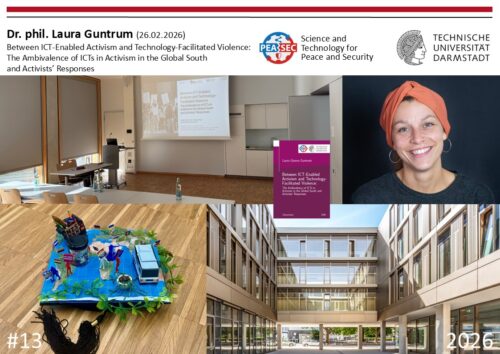
Between ICT-Enabled Activism and Technology-Facilitated Violence: The Ambivalence of ICTs in Activism in the Global South and Activists’ Responses
Over the past decade, global peacefulness has declined in parallel with the rise of authoritarian governance. In response, activists worldwide have mobilized to defend human rights, act as watchdogs, and challenge entrenched social grievances. Their activities increasingly span both physical and digital spaces, with Information and Communication Technologies (ICTs), particularly social media and messaging applications, playing an important role in initiating, coordinating, and sustaining collective action, highlighting the hybrid nature of contemporary activism. While ICTs, through their socio-technical affordances, enable rapid, transnational communication and can lower barriers to participation, they also expose activists to new vulnerabilities, including technology-facilitated violence (TFV) such as large-scale hate speech, doxing, targeted disinformation, surveillance, and internet shutdowns. This dissertation critically examines the ambivalent role of ICTs in contemporary activism in the Global South, highlighting both their emancipatory potential and the risks that accompany their use. As activists often challenge those in power, they are frequently targeted by TFV, which aims to silence dissent, thereby revealing the political nature of this violence. In order to generate in-depth, contextually grounded insights, the study employs a qualitative research design focused on activists (n=100) and civil society organizations working in human rights and digital rights (n=11) from the Global South, specifically in Myanmar, Cameroon, Costa Rica, and Colombia. Prior to data collection, the dissertation develops and reflects on ethical and security considerations for digitally mediated research in sensitive environments.
Existing research rarely addresses how activists from the Global South use ICTs, how socio-political, historical, and technical conditions influence their digital practices, how they are affected by TFV, or how they cope with and respond to it. Addressing these gaps requires an intersectional lens, thereby reflecting on prevailing power imbalances, historical dependencies, colonial legacies, and persistent forms of discrimination. The findings provide a nuanced account of how activists adopt and adapt ICTs in response to local opportunities and constraints shaped by factors such as accessibility, affordability, infrastructure, political conditions, and individual identities. Thereby, particular attention is given to groups frequently marginalized within society, such as women and BIPoC (Black, Indigenous, Person of Color) activists, who encounter distinct barriers to using ICTs and face heightened exposure to (gendered and racist) TFV due to intersecting forms of discrimination.
The findings demonstrate that ICTs play an important role in activism and everyday life, and that all interviewees were affected by some forms of TFV. This underscores the pressing need for more systematic research to identify which types of TFV are most prevalent and how they manifest, particularly given the current lack of studies that examine how activists are affected by TFV and the consequences it carries for their work, well-being, and long-term engagement. The findings also indicate that TFV is often normalized or dismissed by institutions and sometimes by activists themselves, because it is perceived as limited to the online world, despite its profound offline consequences and the blurring boundaries between digital and non-digital spheres. Several interviewees perceived TFV as comparatively less dangerous in contexts where physical violence is significantly more pervasive, highlighting an important contrast with activists operating in less violent (physical) environments. How activists cope with and respond to TFV also varies considerably and depends on their personal threat assessments, with strategies ranging from ignoring incidents of TFV or blocking perpetrators to self-censorship and withdrawal from social media (chilling effects), the adoption of digital-security practices, or, in some cases, intensified resistance. The dissertation provides empirical evidence that the security practices employed by the interviewees often differ from standardized digital security guidelines, which are typically developed in the Global North and do not always align with the risks and resource constraints faced by activists in the Global South.
Drawing on interdisciplinary perspectives from, amongst others, social movement studies, violence research, and Human-Computer Interaction (HCI), the dissertation calls for expanding prevailing understandings of violence and security to encompass their digital dimensions, for strengthening regulatory protections and platform accountability, and for increased resourcing to address TFV more effectively. Furthermore, based on the empirical findings, the dissertation calls for participatory and context-sensitive design and policymaking processes that center the experiences of those most affected by TFV. By foregrounding Global South perspectives, the study rethinks the intersections of security, participation, and activism in an increasingly digitized world. It is important not to underestimate TFV, to take it seriously, and to further investigate how it contributes to long-term erosion of civic space, the loss of critical voices, and the consolidation of dominant narratives.
Dissertation
- Laura Guntrum (2026): Between ICT-Enabled Activism and Technology-Facilitated Violence: The Ambivalence of ICTs in Activism in the Global South and Activists’ Responses
Darmstadt, Germany: Dissertation (Dr. phil.), Department of History and Social Sciences, Technische Universität Darmstadt. doi:10.26083/tuda-7540
Selected Publications within the PhD thesis:
- (1) Guntrum, L. G., Güldenring, B., Kuntke, F., & Reuter, C. (2022). Using digitally mediated methods in sensitive contexts: a threat analysis and critical reflection on data security, privacy, and ethical concerns in the case of Afghanistan. Zeitschrift für Friedens- und Konfliktforschung, 11 (2), 95–128. https://doi.org/10.1007/s42597-022-00088-2 [Chapter 4]
- (2) Guntrum, L. G. (2022). Justice-oriented Research in Peace and Conflict Studies in Times of Social Distancing. In MCI-WS10: 9. Workshop Mensch-Maschine-Interaktion in sicherheitskritischen Systemen. Darmstadt. 4.-7. September 2022. Bonn: Gesellschaft für Informatik e.V. https://doi.org/10.18420/muc2022-mci-ws10-216 [Chapter 5]
- (3) Guntrum, L. G. (2024). Keyboard Fighters: The Use of ICTs by Activists in Times of Military Coup in Myanmar. In Proceedings of the CHI Conference on Human Factors in Computing Systems. New York, NY, USA: Association for Computing Machinery. https://doi.org/10.1145/3613904.3642279 (ICORE-A*1) [Chapter 6]
- (4) Guntrum, L. G., Sunjo, E., & Cockburn, L. (2026). Including perspectives of women using ICTs to promote peace in the Anglophone Cameroon Crisis. Africa Spectrum. (IF: 2.2) [Chapter 7]
- (5) Guntrum, L. G., & Lasso Mena, V. (2025). Unmasking digital threats in the pursuit of human rights and environmental defense in La Guajira, North Colombia. Information, Communication & Society, 1–22. https://doi.org/10.1080/1369118X.2025.2503444 (IF: 4.2) [Chapter 8]
- (6) Cabanzo Valencia, M., & Guntrum, L. G. (2026). Race, Ethnicity, and Technology-Facilitated Violence: The Experience of Activists in Chocó, Colombia. New Media and Society. https://doi.org/10.1177/14614448251344286 (IF: 4.5) [Chapter 9]
- (7) Guntrum, L. G., Forero Nuñez, D., & Reuter, C. (2025). Chilling or resisting? Exploring the influence of technology-facilitated (gender-based) violence on female feminists in Colombia and Costa Rica. Journal of Interactive Media (i-com), 24(2), 433–455. https://doi.org/10.1515/icom-2025-0004 [Chapter 10]
- (8) Guntrum, L. G., & Reuter, C. (2025). Activists’ Strategies for Coping with Technology-Facilitated Violence in the Global South. ACM Transactions on Computer-Human Interaction (TOCHI). https://doi.org/10.1145/3762811 (IF: 6.6; ICORE A*) [Chapter 11]
Projects: