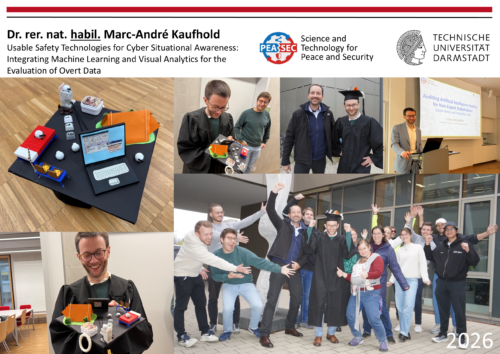
On October, 22, 2026, Dr. Marc-André Kaufhold successfully defended his habilitation thesis at the Department of Computer Science of the Technical University of Darmstadt. At the intersection of cybersecurity and human-computer interaction, his cumulative habilitation thesis comprising ten papers examined usable technologies for cyber situational awareness, focusing on machine learning and interactive visualization for the analysis of public data.
Following the habilitation lecture – comprising a 30-minute teaching demonstration and a 15-minute overview of the habilitation thesis – and the subsequent academic discussion, the habilitation committee has decided to grant him the habilitation in the field of “Applied Computer Science” (German: Angewandte Informatik). In accordance with Section 12 of the Habilitation Regulations of TU Darmstadt, the habilitation is finalized when the dean presents the certificate. This may take place as part of an inaugural lecture.
The entire PEASEC team congratulates Dr. rer. nat. Marc-Andre Kaufhold on the successful defense of his habilitation thesis!
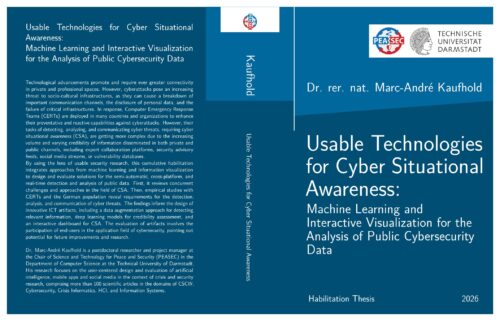
Thesis Overview: Usable Technologies for Cyber Situational Awareness
Technological advancements in the context of digitalization, such as the internet of things, mobile devices, or smart cities, enable, promote, and require ever greater connectivity in private and professional spaces. However, cyberattacks pose an increasing threat to socio-cultural infrastructures, as they can cause a breakdown of important communication channels, the disclosure of personal data, and the failure of critical infrastructures (CI). This has been brought to public attention not least by the 2015 Ukraine power grid attack, resulting in power outages for roughly 230,000 citizens, the 2017 WannaCry ransomware, which infected over 300,000 computers in over 150 countries, the 2018/19 Doxing attack against 1,000 German politicians, journalists and celebrities, or the 2020 University Hospital of Düsseldorf hack, which prevented the conduction of emergency operations and thus facilitated the death of a patient, amongst other more recent examples.
 In response, Computer Emergency Response Teams (CERTs) and IT Security Officers (ITSOs) are deployed in many countries and organizations to enhance their preventative and reactive capabilities against cyberattacks. Amongst others, state-level CERTs provide cybersecurity reports for ministries, consult small and medium-sized enterprises (SMEs), including CI providers, with regard to security incidents, or provide information on how citizens can better protect against cyberattacks. For informed decision-making and action, dedicated personnel must first establish situational awareness on relevant information from cyberspace. However, their tasks of detecting, analyzing, and communicating cyber threats, requiring cyber situational awareness (CSA), are getting more complex due to the increasing volume (i.e., information overload) and varying credibility of information (i.e., information quality) disseminated in both private and public channels, including expert collaboration platforms, security advisory feeds, social media streams, or vulnerability databases.
By using the lens of usable security research, this cumulative habilitation thesis integrates approaches from machine learning and information visualization to design and evaluate solutions for the semi-automatic, cross-platform, and real-time detection and analysis of public cybersecurity data. First, it reviews concurrent challenges of CSA, existing algorithms for the detection of relevant information, and tools for the analysis of public data. Then, empirical studies conducted with CERT employees, ITSOs, and the German population reveal requirements for the detection, analysis, and communication of cyber threats. The findings led to the design of innovative ICT artifacts, including a data augmentation approach for detecting relevant information, deep learning models for assessing the credibility of public data, a novel approach for retrieving security advisories, and an interactive dashboard for CSA. The evaluation of artifacts involves the participation of end-users in the application field of cybersecurity, pointing out potential for future improvements and research.
Teaching Demonstration: Auditing Artificial Intelligence Systems for Non-Expert Stakeholders
With the EU AI Act, the systematic evaluation of AI-based systems has moved to the center of regulatory and scientific attention. Many of the organizations that deploy such systems employ no staff with AI expertise but are nonetheless required to ensure that the classification models they operate are accurate, fair, and legally compliant. This lecture introduces the concept of participatory AI auditing: what constitutes an audit, which dimensions are relevant (bias, robustness, fairness, and explainability), and which process models exist. It further demonstrates how user-centered interfaces can support the continuous auditing of AI systems by domain experts without a technical background – an increasingly practice-relevant challenge at the intersection of human-computer interaction, machine learning, and law. Drawing on examples from hate speech moderation across different jurisdictions, the lecture invites students to reflect on design implications for auditing tools that empower non-expert stakeholders to identify model failures and drive incremental improvements.
Habilitation Thesis
- Marc-André Kaufhold (2026)
Usable Technologies for Cyber Situational Awareness: Machine Learning and Interactive Visualization for the Analysis of Public Cybersecurity Data
Darmstadt, Germany: Habilitation (habil.), Department of Computer Science, Technische Universität Darmstadt. https://tuprints.ulb.tu-darmstadt.de/handle/tuda/16305
Selected Publications within the Habilitation Thesis
- Thea Riebe, Marc-André Kaufhold, Christian Reuter (2021)
The Impact of Organizational Structure and Technology Use on Collaborative Practices in Computer Emergency Response Teams: An Empirical Study
Proceedings of the ACM: Human Computer Interaction (PACM): Computer-Supported Cooperative Work and Social Computing ;5(CSCW2). doi:10.1145/3479865
[Download PDF] - Marc-André Kaufhold, Jasmin Haunschild, Christian Reuter (2020)
Warning the Public: A Survey on Attitudes, Expectations and Use of Mobile Crisis Apps in Germany
Proceedings of the European Conference on Information Systems (ECIS).
[Download PDF] - Marc-André Kaufhold, Julian Bäumler, Marius Bajorski, Christian Reuter (2025)
Cyber Threat Awareness, Protective Measures and Communication Preferences in Germany: Implications from Three Representative Surveys (2021-2024)
Proceedings of the Conference on Human Factors in Computing Systems (CHI) Yokohama, Japan. doi:10.1145/3706598.3713795
[Download PDF] - Marc-André Kaufhold, Julian Bäumler, Marius Bajorski, Christian Reuter (2026)
High Awareness, Moderate Preparedness and Low Trust in Agencies: A Trend Study on Cybersecurity Behavior and Perceptions of German Citizens
ACM Transactions on Privacy and Security (TOPS) (Accepted). - Markus Bayer, Marc-André Kaufhold, Christian Reuter (2023)
A Survey on Data Augmentation for Text Classification
ACM Computing Surveys (CSUR) ;55(7):1–39. doi:10.1145/3544558
[Download PDF] - Markus Bayer, Marc-André Kaufhold, Björn Buchhold, Marcel Keller, Jörg Dallmeyer, Christian Reuter (2022)
Data Augmentation in Natural Language Processing: A Novel Text Generation Approach for Long and Short Text Classifiers
International Journal of Machine Learning and Cybernetics (IJMLC) . doi:10.1007/s13042-022-01553-3
[Download PDF] - Marc-André Kaufhold, Markus Bayer, Daniel Hartung, Christian Reuter (2021)
Design and Evaluation of Deep Learning Models for Real-Time Credibility Assessment in Twitter
30th International Conference on Artificial Neural Networks (ICANN 2021) Bratislava. doi:10.1007/978-3-030-86383-8_32
[Download PDF] - Marc-André Kaufhold, Julian Bäumler, Nicolai Koukal, Christian Reuter (2025)
AdvisoryHub: Design and Evaluation of a Cross-Platform Security Advisory System for Cyber Situational Awareness
Proceedings of the 20th International Conference on Availability, Reliability and Security (ARES 2025) Cham. doi:10.1007/978-3-032-00627-1_3 [Download PDF] - Marc-André Kaufhold, Ali Sercan Basyurt, Kaan Eyilmez, Marc Stöttinger, Christian Reuter (2022)
Cyber Threat Observatory: Design and Evaluation of an Interactive Dashboard for Computer Emergency Response Teams
Proceedings of the European Conference on Information Systems (ECIS) Timisoara, Romania.
[Download PDF] - Marc-André Kaufhold, Thea Riebe, Markus Bayer, Christian Reuter (2024)
‘We Do Not Have the Capacity to Monitor All Media’: A Design Case Study on Cyber Situational Awareness in Computer Emergency Response Teams
Proceedings of the Conference on Human Factors in Computing Systems (CHI) (Best Paper Award) Honolulu, HI, USA. doi:10.1145/3613904.3642368
[Download PDF]
Projects: