
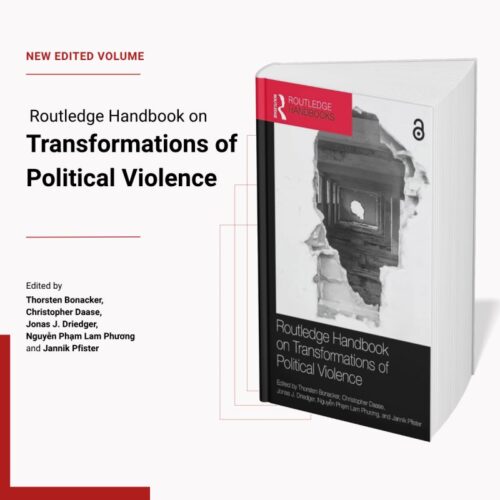
The recent war in Ukraine, new weapons technologies, and blatant violations of international law: the transformation of political violence seems obvious at the moment yet it is far more multifaceted. The “Handbook on Transformations of Political Violence”, published by Routledge on August 24, 2026, explores the less obvious manifestations and transformations of political violence. Edited by Thorsten Bonacker, Christopher Daase, Jonas J. Driedger, Nguyễn Phạm Lam-Phương, and Jannik Pfister, the volume brings together the research of the TraCe research Center.
The Routledge Handbook picks up where the analysis of individual phenomena of violence reaches its limits. It connects different research strands and focuses on new forms of violence, institutional structures, and societal interpretations. In doing so, the Handbook demonstrates that new forms of political violence do not simply replace existing ones; they coexist with, overlap, or transform long-standing conflicts.
The authors address phenomena such as the internationalization of civil wars, digital technologies, the ambivalent role of institutions such as international organizations, and memory culture, language, and political narratives. Contributions from disciplines such as political science, social sciences, anthropology, history, cultural studies, and law, combine diverse theoretical, methodological, and empirical approaches.
Our open-access handbook chapter „Exploring the Transformation of Political Violence through Digital Technologies” (Laura Guntrum, Anja-Liisa Gonsior, Christian Reuter) underscores the duality of ICTs, which, while supporting, e.g., activists to organize and mobilize during periods of political unrest, are concurrently extensively utilized by both state and non‑state actors to perpetrate violence against their critics.
The handbook is available from Routledge and as an open access download in English.